
Press release + reports/consultations below for download
Industry invited to share views on changes to Emissions Trading Scheme
Industries and wider organisations asked for views on proposed changes to the UK Emissions Trading Scheme to support progress to net zero.From:Department for Energy Security and Net Zero, Department for Transport, HM Treasury, Welsh Government, The Scottish Government
Show 4 more — Published 18 December 2023

- New proposals aim to enhance UK Emissions Trading Scheme’s role in supporting decarbonisation
- consultations ask for views on scheme improvements to promote market stability and support businesses in the net zero transition
- the UK Emissions Trading Scheme Authority confirms the scheme will run until at least 2050, providing long-term certainty
Power, aviation and industrial sectors are today (Monday 18 December) being invited to offer their views on proposed changes to the UK Emissions Trading Scheme that will ensure it continues to support progress to net zero across the UK.
Companies under the scheme are required to obtain allowances for every unit of carbon they emit. These allowances are traded between participants, generating a carbon price that spurs businesses to invest in cleaner or renewable energy sources and improved energy efficiency.
In the 2 consultations launched today, the UK Emissions Trading Scheme Authority has set out proposals to ensure the scheme’s market continues to facilitate cost-effective decarbonisation for the businesses involved. This includes options for a new mechanism to manage the supply of carbon allowances in the market.
The consultations also consider support available for energy intensive industries under the scheme. Participants and other organisations will be able to share their views on how best to calculate free allocations of carbon allowances, which ensure efforts from UK industries to decarbonise are not undermined by higher-carbon imports.
Today’s move follows ambitious reforms to the UK Emissions Trading Scheme announced earlier this year. It signals the next step in the scheme’s market-led transition to net zero, alongside long-term economic growth across the UK.
Also today, the Authority has published a response to MP Chris Skidmore’s Independent Review of Net Zero in which it confirms the Emissions Trading Scheme will be extended beyond 2030 to 2050 – providing certainty needed for businesses to invest in decarbonisation.
In a joint statement, UK Emissions Trading Scheme Authority ministers, including Lord Callanan, Julie James MS, Màiri McAllan MSP, Exchequer Secretary Gareth Davies MP and Aviation Minister Anthony Browne MP said:
The UK Emissions Trading Scheme is a cornerstone of our climate policy. Continuing its success means giving industries confidence to invest in decarbonisation.
Today’s plans form the next step in developing the scheme so it can continue to enable the transition to net zero for industries across the UK alongside lasting economic growth.
The 2 consultations will run for 12 weeks until 11 March 2024 and are open to all participants of the UK Emissions Trading Scheme as well as wider organisations. These include trade bodies, market participants, academics, NGOs, and future ETS participants from maritime and waste sectors.
Consultation on Markets Policy
The Authority has today set out plans to ensure the UK Emissions Trading Scheme market continues to offer an effective financial incentive that drives its participants to decarbonise, following a call for evidence last year. The proposals seek to support market stability and provide long-term confidence for participants.
Industries are being asked for their views on a range of potential market policies, including a new Supply Adjustment Mechanism. The Authority proposes introducing this system to help respond to changes in demand within the market that have a long-term impact by amending the amount of carbon allowances available.
The consultation also covers proposals for the Authority to maintain its power to intervene if the carbon price rises rapidly over a sustained period, in what is known as the Cost Containment Mechanism. Other potential measures include maintaining the Auction Reserve Price, which sets a minimum bid level for allowances during auctions – currently at £22.
A Review of Free Allocation
This consultation explores how to better target free allocations of carbon allowances for industries most at risk of carbon leakage – where production and associated emissions are moved from one country to another due to different levels of decarbonisation rules.
The review considers how to improve the free allocation calculation ensuring carbon leakage risk specific to UK industry is accounted for. New proposals will also ensure closed industrial sites do not receive free allocations after they have ceased activity.
This consultation is the final phase of a comprehensive review into free allocation and will allow the Authority to give industries certainty over the support they will receive from 2026.
The Authority is engaging with the UK Government on wider carbon leakage mitigation policies, which were the subject of a consultation in Spring 2023, to ensure any policies progressed work cohesively with UK ETS free allocation.
Related reports
In addition, the Authority has published 4 reports today covering the UK ETS’s current operations and future outlook. These include:
- Response to the Independent Review of Net Zero: The Authority has today set out a long-term pathway for the scheme, in its response to MP Chris Skidmore’s Independent Review of Net Zero. It confirms the scheme will be extended beyond 2030, until at least 2050 – providing the certainty needed for businesses to invest in decarbonisation.
- Review of the Operation of the UK Emissions Trading Scheme: This is the first statutory review of the ETS, concluding the scheme is on track to support the transition to net zero. It offers recommendations to enhance the scheme, by expanding its coverage and making technical amendments to its operation. The Review draws on information collected as part of an independent external evaluation of the scheme, which the Authority is also publishing today.
The Authority is a body comprising the UK government, Scottish Government, Welsh Government and the Department of Agriculture, Environment and Rural Affairs in Northern Ireland that jointly runs the scheme.
Notes to editors
The consultation on the Review of Free Allocations is available here. The consultation on Markets Policy is available here.
The content of these documents has been agreed by senior officials in Northern Ireland in the absence of ministers. The Executive Office will publish their decision to provide agreement as part of the monthly summary reports. The content of the publications announced today does not apply to the power generation sector in Northern Ireland, which continues to participate in the EU Emissions Trading Scheme under the terms of the Windsor Framework/Northern Ireland Protocol.
This consultation closes at
Consultation description
The UK Emissions Trading Scheme (UK ETS) Authority (UK Government, Scottish Government, Welsh Government and the Department of Agriculture, Environment and Rural Affairs for Northern Ireland is seeking input on a number of proposals to develop future markets policy.
The Authority is reviewing ETS markets policy to ensure that it remains fit for purpose and is effective in managing the risks faced by an established and maturing scheme. This will help to maintain stable and effective market conditions that will continue to incentivise decarbonisation in the traded sector.
This consultation seeks views on:
- whether the Authority has identified the most significant risks to effective market functioning
- the suitability of different policy options to address the risks identified
- how individual market stability policies should be designed to most effectively address market risks while minimising intervention and disruption in the market
This consultation is open to all but will be of particular interest to:
- individual companies and representatives of industrial, power and aviation sectors with obligations under the UK ETS
- ETS market traders
- financial institutions and investors
- environmental groups
- individual companies and representatives of maritime, waste, greenhouse gas removals and agricultural sectors
The consultation does not apply to NI electricity generators who participate in the EU ETS by virtue of the Ireland / Northern Ireland Protocol.
Policy paper
The long-term pathway for the UK Emissions Trading Scheme
Published 18 December 2023
Contents
- We are committed to continuing the UK ETS for the long term
- We will continue to develop the UK ETS
- We will explore expanding the UK ETS to more sectors of the economy
- We will continue to consult stakeholders as we set out further details of the long-term pathway for the UK ETS
Print this page
1. The Independent Review of Net Zero emphasised the economic opportunity of net zero and the need to give businesses long-term policy certainty to enable decarbonisation investment. It proposed an enhanced role for the UK Emissions Trading Scheme (UK ETS) as the foundation for a thriving, decarbonised economy through 2050 and beyond. It recommended that the UK ETS Authority develop a long-term pathway for the scheme. [footnote 1] The UK ETS Authority, representing the UK Government, the Scottish Government, the Welsh Government and the Department of Agriculture, Environment and Rural Affairs for Northern Ireland, accepts this recommendation. We are setting out here the steps we are taking to develop that long-term pathway. [footnote 2]
We are committed to continuing the UK ETS for the long term
2. Carbon pricing is an effective, market-based way of allowing businesses to make economically rational decarbonisation investment decisions. [footnote 3] The UK ETS provides a broad-based approach to carbon pricing, supporting competitive markets to drive decarbonisation. The scheme will continue to be an important lever for delivering an economically efficient transition to net zero. Appropriate pricing of emissions in accordance with the polluter pays principle incentivises decarbonisation and green innovation. This gives businesses covered by the UK ETS the flexibility to decide how to decarbonise most effectively. It does so at least cost across the sectors covered by the scheme while providing revenue to help fund public services, including to support the net zero transition. [footnote 4]
3. The UK ETS Authority is therefore announcing today that we intend to legislate to continue the UK ETS beyond 2030 until at least 2050. The scheme will remain aligned with our net zero targets, so giving businesses the certainty they need to invest in decarbonisation. We are also considering extending the next phase of the UK ETS, starting in 2031, for longer than ten years to align it with the dates of UK carbon budgets. We will consult on these proposals as we develop the scheme. We will also take account of the findings of the UK ETS evaluation programme’s assessment of its effectiveness in enabling cost-effective emissions abatement.
We will continue to develop the UK ETS
4. When we set up the UK ETS, we aimed to provide continuity in our approach to carbon pricing as we left the EU. We wanted to give long-term policy certainty for businesses about the role of the scheme in supporting our decarbonisation pathway towards net zero. We committed to aligning the ETS cap with an appropriate net zero trajectory, to exploring expansion of the scheme to more sectors of the economy, and to maintaining a robust carbon pricing signal to give businesses the confidence to mobilise the scale of capital investment necessary to deploy clean energy technologies. [footnote 5]
5. Having established the scheme, the UK ETS Authority has taken initial steps to develop it in line with these commitments. These steps were set out in our response to the consultation on Developing the UK ETS. [footnote 6]
- From 2024, the UK ETS cap will be aligned with the net zero trajectory. We will limit the number of carbon allowances for companies to buy at auction in 2024 to 69 million – 12.4% fewer than in 2023, and their lowest-ever level. By 2027, this will fall to around 44 million – a 45% reduction on 2023 – before reaching around 24 million by 2030.
- We have announced initial expansion of the UK ETS: wider coverage of emissions by sectors already in the scheme, including coverage of CO2 venting by the upstream oil and gas sector from 2025; expansion to domestic maritime emissions in 2026; to energy from waste and waste incineration in 2028; and, subject to consultation, our intention to include engineered greenhouse gas removals (GGRs). As we set out in the response to the consultation on Developing the UK ETS, the Authority believes that the UK ETS may also offer an appropriate long-term market for high quality nature-based GGRs, subject to further work to consider the range of potential issues brought forward through the call for evidence on GGRs and by the Climate Change Committee regarding permanence, costs and wider land management impacts.
- In a connected world, the UK ETS can only be truly effective if action is taken to mitigate the risk of carbon leakage. The UK Government has undertaken extensive consultation on possible measures to mitigate carbon leakage risk including introducing a carbon border adjustment mechanism and has now published a response. Alongside this broader work to address carbon leakage risk, [footnote 7] the UK ETS Authority is reviewing our approach to free allocation of UK ETS allowances. Any new measure or measures will consider the impact on industry and will need to work cohesively with our existing carbon leakage policy measures, especially the allocation of UK ETS free allowances. The Industry Cap on the quantity of allowances available to be distributed for free will be set at 40% of the overall cap. We are conducting a Free Allocation Review to better target support at sectors most at risk of carbon leakage; and aviation free allowances will be phased out in 2026.
- We are also conducting an ongoing market review to set the design of future UK ETS markets policy.
6. We will continue to develop the UK ETS in line with these announcements. We are launching consultations today on markets policy and free allocation. We will consult further on the interaction between the UK ETS and the Carbon Offsetting and Reduction Scheme for International Aviation (CORSIA) in due course. We are also reviewing the operation of the UK ETS since its launch in 2021. We will consult in 2024 on how the UK ETS will be expanded to cover waste and maritime and on the inclusion of GGRs. We are developing a regulatory framework for integrating non-pipeline transport for Carbon Capture, Usage and Storage (CCUS) and will consult on the specific detail in 2024. We will consult on implementing sustainability criteria for biomass. Subject to further consultation, we also intend to include methane and nitrous oxide emissions from the upstream oil and gas sector in the scheme and to review the definition of safety flaring.
We will explore expanding the UK ETS to more sectors of the economy
7. Given the role of carbon pricing in enabling cost-effective decarbonisation, we will also continue to explore expanding the scheme to more sectors of the economy, including high emitting sectors. As we do so, we will take account of the indicative delivery pathway to 2037 by sector that the UK Government published in the Net Zero Strategy, shown in the chart below. [footnote 8] In recognition that each of the Devolved Administrations have their own climate targets and anticipated decarbonisation pathways, we will also ensure these are considered and reflected in our plans. We will ensure that our approach to carbon pricing supports businesses and households in transitioning to a net zero economy, including by mitigating carbon leakage risk, supporting investment in low-carbon technologies and supporting households to ensure a just transition.
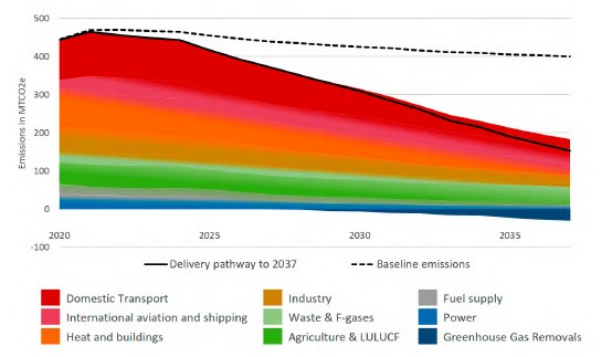
8. We will consider the following five factors as we explore potential further expansion of the UK ETS. We will carry out further assessment and consultation for new sectors before we make any decisions.
- Practicality: we will explore the availability of sufficiently accurate technologies for Monitoring, Reporting and Verification (MRV) of greenhouse gases at appropriate points in the value chain.
- Suitability: we will assess the potential role the UK ETS could have in encouraging decarbonisation for any sector under consideration.
- Business impact: we will take account of the effect that any expansion of the scheme would have on new sectors and on current participants in the UK ETS market.
- Distributional impact: we will consider any adverse impacts on consumers and households and potential mitigations required, including consideration of equality and good relations under the Public Sector Equality Duty, before any expansion of the UK ETS.
- Timing: the timing for inclusion of individual sectors will depend on the stage of their decarbonisation pathway; some sectors could be phased into the scheme over several years.
9. We will explore the potential role of emissions trading markets in gas/electricity price rebalancing as we consider options for rebalancing policy costs away from electricity and onto fossil energy use when the current high gas prices fall.
10. We do not propose expanding the UK ETS to agriculture at this time. However, using findings from the call for evidence on the role of robust MRV of greenhouse gas emissions on farms in last year’s UK ETS consultation and additional evidence from ongoing research projects, in England the UK Government will develop a harmonised approach for measuring carbon emissions from farms, which could help unlock new routes to decarbonisation.
We will continue to consult stakeholders as we set out further details of the long-term pathway for the UK ETS
11. Throughout the development of the UK ETS, we will undertake full consultation on our proposals to ensure that it remains fit for purpose: a broad-based carbon pricing market to limit greenhouse gas emissions, so helping to deliver cost-efficient decarbonisation, tailored to the needs of the UK economy over the course of our transition to net zero.
- Mission Zero: The Independent Review of Net Zero final report (HMSO, 13 January 2023), page 276. ↩
- This also meets a commitment made by the UK Government in Powering Up Britain: The Net Zero Growth Plan (DESNZ, 30 March 2030), page 55. ↩
- This idea has been a mainstay of economics since Pigou (1920) formalised it. For its application to climate change see the Stern Review (2006). For an empirical study of the effectiveness of carbon pricing see Colmer et al (2020), or Martin et al (2016) for a review of evidence on the impacts of the EU ETS. Economic institutions or groups supporting economy-wide carbon pricing include, in the UK: the Institute for Fiscal Studies (2016), Policy Exchange (2018), Bright Blue (2021), the Adam Smith Institute (2021), the Institute for Public Policy Research (2021) and the Tony Blair Institute for Global Change (2022). Internationally: OECD (2019), World Bank (2022), IMF (2021), International Energy Agency (2021), Global Commission on the Economy and Climate (2018). ↩
- See the Net Zero Review Final Report (HMT, 19 October 2021), page 68. ↩
- Energy White Paper: Powering our net zero future (BEIS, 18 December 2020), page 129. ↩
- Main Response to the Consultation on Developing the UK ETS (UK ETS Authority, 3 July 2023). ↩
- Addressing carbon leakage risk to support decarbonisation: Consultation (HMT and DESNZ, 30 March 2023). ↩
- Net Zero Strategy: Build Back Greener (BEIS, 19 October 2021, data updated 2 April 2022), page 18. ↩
Independent review – reports
