
Reporting and opinion by Mathew Carr, Autocar, LinkedIn
July 15-16, 2025: UK government: [A science based corporate target] [that we consider verified] is one that has been validated by the Science Based Target initiative [SBTi] would be required to win EV subsidies, Autocar reports.
CarrZee: While the SBTi doesn’t favor carbon credits, the UK govt may insist that companies must deal with a portion of their “scope 3” emissions using carbon credits. Scope 3 emissions are those created by using a product, after it is sold, plus emissions from suppliers. [correct, more clear]
And before you say EVs don’t create emissions after they are sold …they create emissions if the electricity used to power them is produced partly by natural gas…and sellers of EVs often also sell gasoline-powered and hybrid cars. (Scope 1 and 2 emissions are those produced directly while building the EV and supplied power/energy, respectively.) [correct, more clear]
See this Autocar story….which seems to be breaking the news:
https://apple.news/AtyFte4A9TUiqrJ2YcXKkaQ
EV grants are back: UK government to offer £3,750 discount on new electric cars
Electric Car Grant will provide discounts on cars priced below £37k – subject to sustainability criteria
Subsidies could apply from tomorrow
CarrZee: America loves corporate welfare instead of making polluters pay … so this kind of new UK subsidy system might work in the USA.
CarrZee: Carbon assets might rise on this, downward pressure on crude prices might increase because the subsidies will lower sales of combustion cars. (not investment advice)
This is not a MEGA project (make England great again)

See this LinkedIn post for some ideas about how to make carbon credits more credible in the UK.
Simon Puleston Jones:
Emral Carbon’s heretical response to the UK government’s consultation on voluntary carbon and nature markets*
I’m delighted to have submitted Emral Carbon’s response. We:
1. called for the Digital Markets Bill to be updated to expressly state that verified carbon credits are an asset to which proprietary rights can attach
2. rejected the proposal that VCMI’s Claims Code be considered international best practice (5 adoptees globally, in two years, does not = best practice)
3. strongly endorsed ICVCM’s Core Carbon Principles
4. proposed that all companies in scope of the UK ETS be required to purchase high-integrity verified carbon credits, to compensate for a given percentage of their unabated emissions each year (which % ratchets up over time)
5. quoted a recent press release published by UK Govt, as a member of the Coalition to Grow Carbon Markets, that stated “Carbon markets direct finance to projects that can cut emissions FASTER and at LOWER COST” and, heretically, suggested that:
(i) this is a strong argument NOT to follow the prevailing wisdom that companies should prioritise within-value chain decarbonisation ahead of purchasing and retiring high-integrity verified carbon credits (i.e. we rejected the “mitigation heirarchy” 😲, on the basis that the goal is to reduce/remove GLOBAL GHG emissions as quickly, efficiently and cost-effectively as possible, NOT value-chain by value-chain decarbonisation)
(ii) there should be no cap on the use of high-integrity verified carbon credits for scope 3
(iii) there should be no end date for the use of high-integrity verified carbon credits
6. called for ACTION to be prioritised and championed over endless target setting and reporting obligations
7. called for Principal 1 to be replaced by the principle that “It is better for a company to voluntarily purchase high-integrity verified carbon credits than to take no action to compensate for its unabated emissions” and that another new principle should be “To ensure that there are consequences for each company that fails to compensate for their unabated emissions at all”
8. proposed that the City of London Corporation take over from VCMI
9. encouraged UK Govt to procure a statement from the G20 in support of the use of high-integrity verified carbon credits by corporates
10. supported insetting
11. encouraged the regulation of carbon credit rating agencies and other market participants, whilst calling out the lack of accountability of standards for poor MRV
12. proposed that the use of high-integrity verified carbon credits be a mandatory component of net zero transition plans
13. asked UK Govt to directly publish principles for companies to follow in making green claims, by COP30
14. suggested that Standards insisting that only their registry be used for their credits is anti-competitive
15. noted that UK Govt’s approach to Corresponding Adjustments under Art. 6 conflicts with the CCPs and called for CAs to be available to UK projects
The G20 has a live consultation:
Relevant SBTi consultation.

UK Press release
New £63 million boost for Britain’s electric vehicle revolution
Funding will help to build a fairer, cleaner future where every family can benefit from cheaper, greener transport.From:Department for Transport, Office for Zero Emission Vehicles, NHS England, The Rt Hon Heidi Alexander MP and Karin Smyth MP
Published 13 July 2025

- major boost to charging investment to break down barriers to electric vehicle ownership and boost charging infrastructure across the UK, cutting costs for families, businesses and the public sector
- £63 million package to support at-home charging for households without driveways, transition NHS fleets to save millions for the health service in England, create thousands of chargepoints at business depots across the UK
- builds on £400 million invested in charging infrastructure and recent Zero Emission Vehicle Mandate updates to kickstart economic growth, create thousands of green jobs, and put more money in people’s pockets as part of the Plan for Change
Drivers across England are set to benefit as the government today (13 July 2025) announces a £63 million investment package to supercharge Britain’s electric vehicle infrastructure, driving down charging costs and putting money back in the pockets of working people as part of the Plan for Change.
A pioneering £25 million scheme for local authorities will expand access to cheaper at-home charging. This will provide access to cheaper household rates, allowing consumers to save up to £1,500 a year compared to running a petrol or diesel car, transforming how thousands of households without driveways power up their electric cars.
The innovative cross-pavement technology will allow cables to run safely beneath pavements, connecting homes directly to parked vehicles, enabling more families to tap into cheaper domestic electricity rates for as little as 2 pence per mile even if they don’t have a driveway.
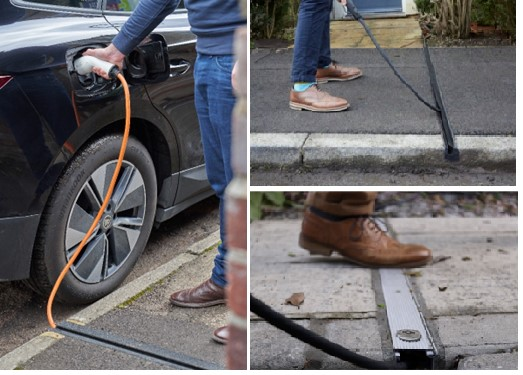
The fund is the latest move to bolster the UK’s growing charging network which has reached a record 82,000 public chargepoints, with a further 100,000 expected to be installed as a result of the government’s Local EV Infrastructure Fund and £6 billion of private investment committed to 2030.
To ensure the savings the EV transition can bring are felt in the public sector too, the NHS in England is also receiving a major sustainability upgrade with an £8 million fund to power the electrification of ambulances and medical fleets across over 200 NHS sites, saving millions in costs which can be invested into patient care.

See a list of NHS trusts that are receiving funding to install electric vehicle chargepoints.
Standing firmly on the side of British drivers, this latest investment is part of our major plan to support motorists, including a record £1.6 billion invested to tackle potholes and bring down and frozen fuel duty at 5p until Spring 2026, saving the average motorist £50 to £60 over the year.
This investment underpins the government’s Plan for Change mission to kickstart economic growth and make life easier for working people, ensuring the transition to net zero delivers for working families whilst creating good jobs and driving economic growth across all regions of the UK.
Transport Secretary Heidi Alexander said:
We are making it easier and cheaper to own an electric vehicle. We know access to charging is a barrier for people thinking of making the switch, so we are tackling that head on so that everyone – whether or not they have a driveway – can access the benefits of going electric.
Our investment is about more than just charging points – it’s about charging up Britain’s economy. I’m proud that through this boost, we are helping deliver cheaper bills for families, massive savings for the NHS to reinvest in patient care, and thousands of new green jobs.
This is what our Plan for Change mission to kickstart Britain’s economy looks like in practice. We’re not just boosting charging infrastructure, we’re building a fairer, cleaner future where every family can benefit from cheaper, greener transport, whilst creating thousands of good jobs across the country.
In a pioneering move to help EV drivers plug into the rapidly expanding charging network, government is also modernising EV charging signage on major roads. EV charging hubs have more than doubled since the beginning of 2023 and immediate changes will allow larger EV charging hubs to be signposted from major A-roads for the first time. Government is committed to boosting charging for long journeys, with £400 million announced in the Spending Review to support charging infrastructure, including on the strategic road network.
Alongside the boosts for electric car drivers, the government is also launching a major new grant scheme to help businesses install charging points at depots nationwide, supporting the nation’s heavy goods vehicles, vans and coach drivers in the transition to zero emissions.
The action follows recent updates to the Zero Emission Vehicle (ZEV) Mandate to make it easier for the sector to switch to electric as part of government’s ongoing work to back British manufacturing. With over 1.2 million people employed in the freight and logistics sector in the UK alone, today’s announcement is the latest move to keep industry at the forefront of international competition in the face of global economic headwinds.
Over 1,200 new charging sockets will deliver a more efficient, modern health system whilst generating millions in cost savings over the next two decades for the taxpayer on maintenance and fuel costs – valuable savings that can be prioritised for patient care and help rebuild the NHS.
Owning and buying an EV is becoming increasingly cheaper, with 2 in 5 of used electric cars sold at under £20,000 and 34 brand new electric cars are available from under £30,000.
The UK was also the largest EV market in Europe in 2024 and the third in the world with over 382,000 EVs sold – up a fifth on the previous year. There are now more than 82,000 public chargepoints in the UK – with one added every 30 minutes – ensuring that motorists are always a short drive from a socket.
Health Minister Karin Smyth said:
This is a win-win: cheaper travel for the NHS and cleaner air for our communities.
As part of our Plan for Change, we’re investing in green energy to build an NHS fit for the future — cutting pollution and saving millions in fuel costs.
Edmund King, AA president, said:
There are more public chargers than people realise, but they are often hidden in plain sight. Increasing signs for the public network is vital to help the EV transition as it will create confidence for drivers both now and in the future.
It is great to see more support for those without off-street parking so that they can also benefit from the EV revolution.
Delvin Lane, CEO, InstaVolt said:
We are pleased that the government has taken the crucial step of delivering official EV charging signage on the strategic road network – a move we believe will improve consumer confidence and bolster EV adoption. This marks a major milestone for the EV industry and drivers across the UK.
At InstaVolt, we have been relentless in our campaigning and have built a strong, collaborative relationship with the government to push this initiative forward. Our opinion research suggests that the rollout of clear, official signage will make a significant difference—helping EV drivers easily locate public charging points while on the move, and reassuring those considering making the switch to electric vehicles.
For years, we have emphasized that the UK’s public EV infrastructure, so critical to mass adoption, is already largely in place, and now this signage will finally showcase it to drivers in a visible, accessible way.”
As the UK’s largest ultra-rapid public charging network with over 2,000 chargers nationwide, InstaVolt is proud to be at the forefront of this transformation and excited to see how these signs will accelerate the adoption of electric vehicles.
Ian Johnston, CEO, Osprey:
Signage impacts all the UK’s drivers because consumers need to see it to believe it. Osprey have tirelessly highlighted the benefit that clear EV road signage would bring to drivers looking to make the switch and to the charging businesses installing the critical infrastructure underpinning transport decarbonisation.
This is a welcome first step and we look forward to continuing to work closely with ministers and officials to achieve clear signage for the hundreds of high-quality EV charging hubs being opened across the nation.
NHS Chief Sustainability Officer Chris Gormley said:
The NHS has already implemented hundreds of projects that reduce emissions and drive significant cost savings, all while improving patient care.
This new £8 million investment, across 62 NHS Trusts and around 224 sites, supports the renewed commitment in the government’s 10 Year Health Plan to deliver a more sustainable NHS while also helping hospitals to save millions on fuel and maintenance costs and reducing air pollution. These savings can be reinvested directly into frontline care, ensuring the NHS continues to deliver for our patients and communities.
Vicky Read, CEO of ChargeUK said:
With 82,000 public charge points already installed across the UK, this positive action on strategic road signage will help more drivers see the extensive charging network that’s rapidly being built across the country. This has been a priority for our industry and will boost consumer confidence in making the switch to electric vehicles.
Our members are investing £6 billion to ensure the deployment of charging infrastructure stays ahead of demand. Today’s announcement shows government recognising the vital role charging plays in the transition, and we look forward to working together to maintain the UK’s position as Europe’s leading EV market.
Roads media enquiries
Media enquiries 0300 7777 878
Switchboard 0300 330 3000
Share this page
The following links open in a new tab
Updates to this page
Published 13 July 2025
[…] https://carrzee.org/2025/07/15/ev-sellers-with-science-based-targets-to-get-massive-subsidies-drivin… […]